
Two-Strand Styles That Offer Softer Texture
Twist Hairstyles in Randallstown for clients who want protective styling with a more relaxed, rope-like appearance
Twists differ from braids in that they use only two sections of hair wrapped around each other rather than the three-strand technique used in traditional braiding, which creates a rope-like texture that's slightly softer and less rigid. If you want a protective style that hangs loosely but still tucks your natural hair away from daily manipulation, twist hairstyles provide that middle ground. BraidedbyDora installs various twist styles in Randallstown, including Senegalese twists, passion twists, rope twists, Havana twists, and Marley twists, each differentiated by the type of extension hair used and the thickness of the final twist.
Senegalese twists use smooth, silky extension hair that creates sleek, shiny ropes, while Marley twists rely on coarser, textured hair that mimics natural afro-textured hair and produces a fuller, more matte finish. Passion twists incorporate pre-curled or wavy extension hair, resulting in twists that have built-in texture and bounce rather than hanging straight. Havana twists are thicker and heavier, using chunky extension hair for a bold, statement look that installs faster than smaller twist sizes. Rope twists can refer to two-strand twists done with your natural hair alone, or they can describe the twisting technique itself when extension hair is added.
Request an evaluation to determine which twist style suits your hair length, texture, and how much weight you're comfortable carrying.
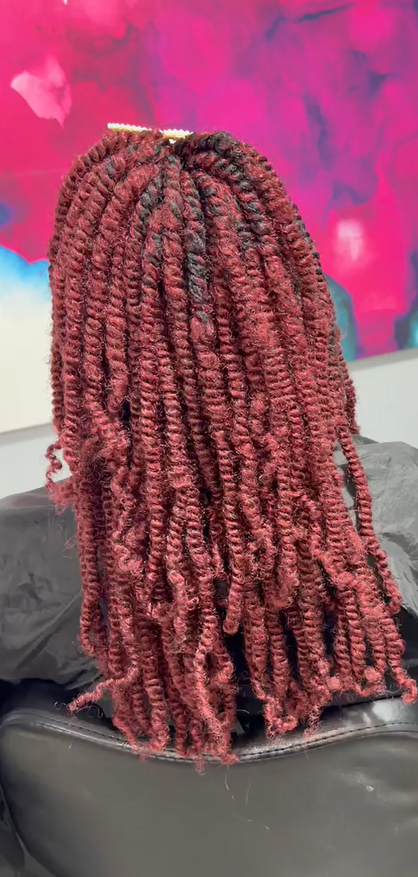
What Separates Quality Twist Installation
The key to durable twists lies in how tightly the two sections are wrapped around each other and how securely the extension hair is attached at the root—loose twists unravel quickly, while overly tight twists cause scalp discomfort and can lead to breakage when you take them down. Your stylist sections your hair, attaches the extension hair using a wrapping or knotting method, then twists the combined hair in a consistent direction from root to tip. Dipping the ends in hot water seals synthetic extension hair and prevents unraveling, a step that's critical for maintaining the style's integrity over several weeks.
After your twists are installed, you'll see uniform, rope-like sections hanging from your scalp, with each twist starting flush at the root and spiraling down to the sealed end. The style moves more fluidly than box braids because the two-strand structure is less dense, allowing the twists to swing and shift naturally. Depending on the size and type of twist, the style lasts four to eight weeks—Senegalese and Marley twists tend to hold longer because the extension hair has more grip, while passion twists may loosen sooner due to the pre-curled texture creating more surface area for friction and frizz.
You maintain twists by applying lightweight oil to your scalp, wrapping your hair at night with a satin scarf or bonnet, and occasionally spritzing the length with water or a moisturizing spray to keep the hair supple. Unlike braids, twists can sometimes be carefully unraveled and retwisted if a few sections come loose, though this depends on how the extension hair was attached initially. Smaller twists take significantly longer to install but offer more styling versatility for updos and ponytails, while larger twists complete faster and create a bolder visual impact with less weight and tension on your scalp.
Questions Property Owners Usually Ask
Clients often ask about the differences between twist types, how long installation takes, and which styles work best for specific hair textures in Randallstown.
What's the main difference between Senegalese twists and Marley twists?
Senegalese twists use smooth, synthetic hair that creates a sleek, shiny finish and hangs straighter, while Marley twists use coarser, textured hair that looks and feels more like natural afro-textured hair, producing a fuller, matte appearance with more volume and a less polished look.
How long do passion twists typically last compared to other twist styles?
Passion twists usually last four to six weeks because the pre-curled texture creates more friction and frizz over time, whereas Senegalese or Havana twists can last six to eight weeks since the smoother or thicker extension hair holds its structure better and resists unraveling longer.
Why do some twists unravel at the ends even after sealing with hot water?
Twists unravel at the ends if the water wasn't hot enough to fully melt and fuse the synthetic fibers, if the ends were trimmed after sealing, or if the twists experienced excessive friction from clothing or rough handling before the seal fully set—resealing loose ends with a lighter flame or additional hot water usually resolves the issue.
What size twists work best for fine or low-density hair?
Medium to large twists work best for fine or low-density hair because they require fewer individual sections, which reduces the total number of attachment points on your scalp and minimizes cumulative tension—smaller twists may look sparse or create too much pull on fragile hairlines.
When should you choose rope twists over other protective twist styles?
You should choose rope twists when you want a style that uses minimal or no extension hair, when you prefer the look of your natural hair texture, or when you need a shorter-term protective option that you can take down and redo more frequently without committing to the longer lifespan and weight of extension-heavy styles like Senegalese or Havana twists.
BraidedbyDora provides Senegalese twists, passion twists, rope twists, Havana twists, and Marley twists as protective styling options for clients who prefer the softer, two-strand texture that twists offer compared to traditional braiding. Schedule your appointment to discuss which twist style matches your hair goals and maintenance preferences.